
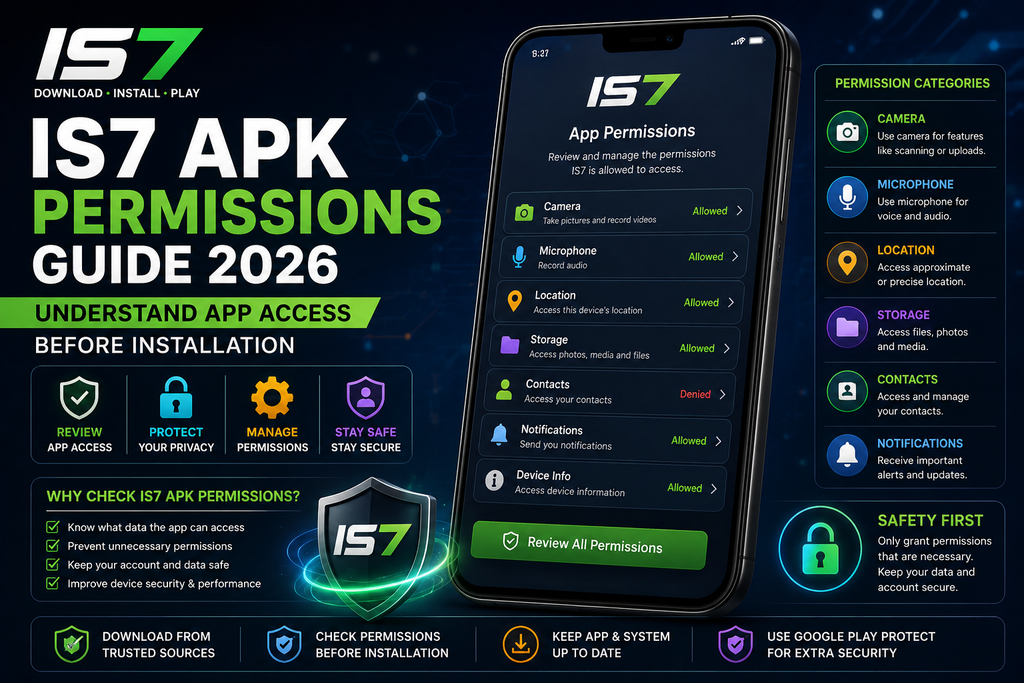
Before installing any Android application, it is important to understand what access the app may request from your device. The same principle applies when downloading an IS7 APK from a source outside the Google Play Store.
An app may request access to certain device features or information to provide specific functions. However, users should always review permissions carefully and avoid granting access that does not appear necessary.
In this IS7 APK permissions guide, we explain how to check app permissions, what common Android permissions mean, how to identify unusual requests, and how to manage permissions safely in 2026.
What Are IS7 APK Permissions?
IS7 APK permissions are access requests that an Android application can make to use particular device features or information.
Android controls these permissions through its permission system. Depending on the Android version and the type of permission, users may be able to allow access, deny it, or provide limited access.
Examples of information or features that can have permission controls include:
- Camera
- Microphone
- Location
- Contacts
- Photos and videos
- Files and media
- Notifications
- Nearby devices
The exact permissions associated with an IS7 APK should be checked on the specific APK version you intend to install.
Why Should You Check APK Permissions?
Permissions can provide useful information about how an application interacts with your device.
Checking permissions before installation can help you:
- Understand requested device access
- Identify permissions that appear unnecessary
- Protect personal information
- Reduce unnecessary data access
- Make better installation decisions
- Detect potentially suspicious APK behavior
Android provides tools such as Permission Manager and Privacy Dashboard to help users review application access.
How to Check IS7 APK Permissions Before Installation
When downloading an APK outside an app store, do not assume that the file is safe simply because its name contains “IS7.”
First verify the source of the APK and then review the permissions available for the installed application.
If the APK is already installed, you can normally review its permissions through Android settings.
A general process is:
- Open Settings on your Android phone.
- Go to Apps or Applications.
- Find the IS7 application.
- Open Permissions.
- Review the permissions that are allowed or denied.
- Disable permissions that are not required for functions you use.
The exact menu names can vary between Android manufacturers and operating-system versions.
Common Android Permissions Explained
Not every application needs every permission. Understanding what different permissions provide can make it easier to evaluate an APK.
Camera Permission
Camera access allows an application to use the device camera when the operating system grants that permission.
If an app does not provide a feature that clearly requires camera access, users should question why camera access is being requested.
Microphone Permission
Microphone access can allow an application to record or use audio input.
For privacy, only grant microphone access when you understand why the application needs it.
Location Permission
Location permissions can provide an app with approximate or precise location information, depending on the permission granted and the Android version.
Android allows users to control how location access is shared, including choosing approximate or more precise location in supported situations.
Contacts Permission
Contacts access can allow an application to read information from the device’s contacts.
This is sensitive information, so users should consider whether contact access is genuinely necessary for the application’s intended functionality.
Photos and Videos
Photo and video access can allow an application to work with selected media or broader media access depending on the Android version and implementation.
When possible, use limited or selected access instead of granting broader access than necessary.
Files and Storage Access
Some applications may need to work with files stored on the device.
However, broad file access can create additional privacy risks. Android and Google Play policies place restrictions around sensitive storage access, particularly broad access to files and directories.
Notification Permission
Notification access allows an application to display notifications.
This permission generally does not provide access to your photos, camera, or location, but users should still review notification settings according to their preferences.
Which Permissions Should You Be Careful About?
Some permissions can provide access to particularly sensitive information or device capabilities.
Pay closer attention when an APK requests access to:
- Contacts
- Location
- Camera
- Microphone
- Messages
- Call logs
- Broad file or storage access
- Special device privileges
The important question is not simply whether a permission is “dangerous.” Instead, consider whether the requested access makes sense for the application’s actual functionality.
Google’s Android security guidance recommends minimizing permission requests and only requesting access that is necessary for the application’s functionality.
What If an IS7 APK Requests Too Many Permissions?
If an APK requests permissions that seem unrelated to what the application does, stop and investigate before continuing.
For example, an application that appears to provide a simple gaming experience may deserve additional scrutiny if it unexpectedly requests extensive access to unrelated personal information.
Do not automatically approve every permission request.
Instead:
- Read the permission request.
- Consider why the app might need it.
- Check the APK source.
- Look for trustworthy information about the application.
- Scan the APK where appropriate.
- Deny unnecessary access when possible.
How to Manage IS7 Permissions After Installation
You do not have to treat permissions as permanent.
Android provides controls that allow users to review and change permissions after an application has been installed.
A typical process is:
Settings → Apps → IS7 → Permissions
From there, you can review available permission categories and change access where Android provides the option.
Android’s Permission Manager also provides a central way to review sensitive permissions across applications.
What Happens If You Deny a Permission?
Denying a permission does not necessarily mean that the entire application will stop working.
If a particular feature depends on a permission, that feature may not work correctly without the required access.
For example, if an application genuinely needs camera access for a specific feature and you deny camera permission, that feature may be unavailable.
Android’s permission model allows users to deny individual permissions rather than automatically granting every requested permission.
Check Permissions Again After Updates
Permission requirements can change when an application is updated.
For this reason, users should not assume that a previously installed version has exactly the same requirements as a newer APK.
Before installing a new IS7 APK version:
- Verify the download source
- Check the version information
- Review available permissions
- Scan the file where appropriate
- Keep Android security features enabled
- Remove unnecessary permissions after installation
IS7 APK and Google Play Protect
If you install an APK from outside Google Play, extra caution is appropriate.
Google Play Protect checks applications and can also scan applications installed from sources outside Google Play. It may warn users about potentially harmful applications and can disable or remove harmful software.
Google recommends keeping Play Protect enabled.
To check it:
- Open the Google Play Store.
- Tap your profile icon.
- Select Play Protect.
- Open Play Protect settings.
- Make sure app scanning is enabled.
The exact interface may vary between Android versions.
How to Identify Suspicious APK Behavior
Permissions are only one part of APK safety.
Be cautious if you notice several warning signs together, such as:
- Download links from unknown websites
- Unexpected redirects
- Requests to disable security protections
- Excessive permissions
- Modified or unofficial APK claims
- Unexpected pop-ups
- Unusual background activity
- Requests for sensitive information without a clear reason
Google specifically warns that potentially harmful apps can come from sources outside Google Play, which is why Play Protect scanning is useful for sideloaded applications.
Should You Allow Every IS7 Permission?
No.
Users should review each requested permission and decide whether it is appropriate for the feature being used.
A good rule is:
Only provide the access an application actually needs.
If you are unsure why a permission is being requested, do not immediately approve it. Investigate the application’s documentation and source first.
IS7 APK Permission Checklist
Before installing an IS7 APK, check the following:
- Verify the download source.
- Confirm the APK version.
- Review the requested permissions.
- Look for permissions unrelated to the app’s purpose.
- Keep Google Play Protect enabled.
- Scan the APK when appropriate.
- Avoid modified or suspicious APK files.
- Review permissions after installation.
- Disable unnecessary access.
- Keep your Android device updated.
Final Thoughts
Understanding IS7 APK permissions is an important part of making safer Android installation decisions.
The exact permissions can vary between APK versions, Android releases, and how the application is distributed. Therefore, users should check the actual permission information for the version they are installing instead of relying on an old permission list.
Android gives users tools to review and control access to sensitive information, while Google Play Protect provides additional protection against potentially harmful applications.
Before installing any APK, verify its source, review its permissions, keep security protections enabled, and avoid granting unnecessary access.
Frequently Asked Questions
Does every IS7 APK request the same permissions?
Not necessarily. Permission requirements can change between application versions and Android versions. Always check the specific APK you are installing.
Can I change IS7 permissions after installation?
Yes. Android provides permission controls through the application’s settings page and Permission Manager.
Should I allow every permission requested by an APK?
No. Review each permission and consider whether it is necessary for the feature you want to use.
Is an APK automatically safe if it installs successfully?
No. Successful installation does not prove that an APK is trustworthy. Check the source, permissions, and security warnings.
Should Google Play Protect remain enabled?
Yes. Google recommends keeping Play Protect enabled because it can scan applications, including apps installed from outside Google Play.
Can Android reset permissions automatically?
On supported Android versions, permissions for unused apps can be reset automatically as part of Android’s privacy protections.